Mercedes Eight From Eleven: The Class Field Skeleton As Break Begins
Mercedes have won eight of eleven races and the paddock's mid-season chase is now defined by catching Kimi Antonelli.
The paddock has dispersed for its traditional three-week mid-season break, but the competitive picture crystallising across the first eleven rounds leaves little room for ambiguity. Mercedes arrived as pre-season favourites and have delivered on that billing with a authority that has surprised even their own strategists: eight wins from eleven meetings, a strike rate that exceeds internal projections and places the squad firmly at the summit of the current grid hierarchy.
A Power Unit Advantage That Defies the Spec Sheet
The headline numbers tell one story. The technical reality beneath them is more nuanced and, for rivals, considerably more troubling. An engine assessment conducted by Aduo declared the Red Bull power unit the cream of the crop, but that conclusion deserves scrutiny. The Aduo methodology ranked engines on the basis of internal combustion output alone, a metric that captures only one dimension of a modern Formula 1 power unit's contribution.
The omission matters because contemporary F1 performance is increasingly governed by hybrid electrical deployment. The energy recovery systems, the battery management strategies, the deployment maps out of corners and along straights: these are the elements that translate raw combustion output into usable lap time. On that broader and more representative measure, the Mercedes power unit is without doubt the class of the field. The hybrid electrical element, now so central to competitive performance, is where Mercedes have built their most decisive advantage.
Rivals who benchmark themselves against the Aduo combustion figures risk calibrating their development against a partial picture. The gap to close is not simply in cylinder pressure. It is in the integration of the electrical systems with the combustion engine, in the software that manages energy flow, and in the cooling architecture that allows Mercedes to run aggressive deployment modes without thermal degradation.
Eight Wins and the Strike Rate Nobody Expected
8/11 is a dominant conversion rate by any era's standards, and it is the consistency rather than individual brilliance that should concern the opposition. Mercedes have not merely produced the fastest car on its day; they have produced a platform that performs across circuit characteristics, tyre demands, and ambient conditions.
The team's own expectation coming into the season was for competitive advantage, not for this level of unopposed conversion. Pre-season testing suggested a clear edge, but translating potential into race wins requires reliability, strategic execution, and a driver capable of managing races from the front. All three components have delivered.
The race is on to catch Kimi Antonelli.
That single line from the paddock narrative frames the second half of the season. The pursuit of Antonelli is now the defining competitive thread, and it is a pursuit that speaks to both Mercedes' strength and the grid's vulnerability. When the dominant team's junior prospect becomes the reference point for the chasing pack, the competitive hierarchy has settled into a familiar and uncomfortable shape for everyone outside that organization.
The Architecture of the Gap
Combustion Output Versus Total Power Unit Performance
The Aduo assessment is worth dissecting because it highlights a recurring tension in how F1 performance is evaluated. Internal combustion output is measurable, comparable, and historically meaningful. It is also, in the current regulatory cycle, an incomplete proxy for actual competitive potential.
Mercedes' advantage compounds across the lap. A superior combustion engine would deliver performance in the power-limited phases of a lap, primarily on straights and through fast corners where throttle application is sustained. A superior hybrid system delivers performance everywhere: additional torque out of slow corners, energy deployment along straights that catches rivals off-guard, and regeneration strategies that preserve battery life across a stint.
The tracks where Mercedes have converted their advantage illustrate this point. High-speed circuits reward aerodynamic efficiency and combustion output. Technical circuits reward energy recovery and deployment precision. Mercedes have won on both profiles, which points to a power unit that is not excelling in one dimension but across the full operational spectrum.
What the Break Means for Development
Three weeks off track is not three weeks off the development curve. Factory timescales operate with different rhythms. Wind tunnel data accumulated through the early-season races hits the manufacturing phase during the break. Upgrades specified before the summer rounds arrive on cars when the paddock reconvenes.
For Mercedes, the break consolidates a position of strength. Their development trajectory can afford to target marginal gains, refining reliability and drivability rather than chasing a fundamental performance step. For the opposition, the break is a development sprint with a narrowing window. Every race weekend that passes without meaningful convergence on Mercedes' power unit and aero platform compounds the strategic problem: chase performance and risk reliability, or consolidate and accept the gap.
The Chase Defined by a Single Name
The reference to Antonelli as the benchmark for the field to catch carries weight beyond headline value. It signals that Mercedes' competitive position is not restricted to race wins accumulated this season. The pipeline is producing talent calibrated to the car, and the opposition is now measuring itself against a moving target that spans both current performance and future potential.
For Red Bull, the Aduo combustion advantage offers a thread of encouragement. If they can close hybrid deployment deficit across the remaining rounds, the underlying combustion performance provides a competitive base. The challenge is that the hybrid gap is not a single-component problem; it touches energy store architecture, control electronics, and the software integration that governs how those systems interact under race conditions.
The championship standings reflect the competitive reality. With Mercedes converting eight of eleven, the points buffer is substantial, and the development race for the chasing teams is now as much about positioning for next season's regulations as it is about contesting the current campaign.
The break will end. The factories will keep running. And when the cars return to the track, the question will be whether anyone has found enough to alter a dynamic that, through eleven rounds, has been defined by one team, one power unit, and one name the rest of the field is chasing.
Editorial Integrity
This is an original SportPulse article written by our editorial team. All content is independently researched, written, and reviewed by our writers and editors before publication. We do not publish copied, aggregated, or syndicated content.
SportPulse is committed to original sports journalism. Read our editorial policy or contact us with any questions.
More Like This
All f1
Mansell Sees a New F1 Power Shift as Mercedes Reinvents Itself
Nigel Mansell's voice still carries weight in British motorsport — and the current F1 landscape gives him plenty to discuss.
F1 Claims Major Sustainability Milestones as Net Zero 2030 Deadline Looms
Formula 1's latest Impact Report signals real progress on its ambitious Net Zero 2030 pledge — but can the sport truly deliver?
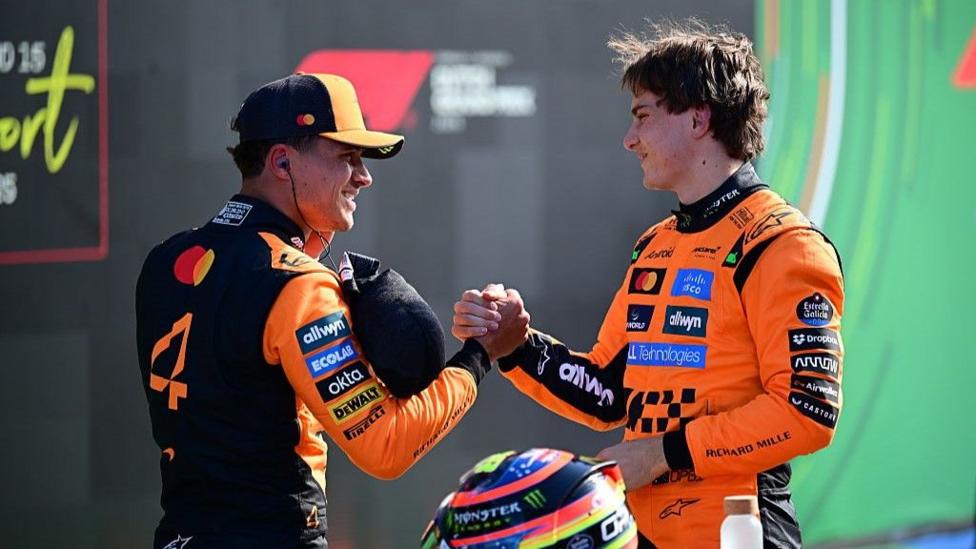
Papaya Rules Decoded: McLaren's Championship Gamble
McLaren's 'Papaya Rules' dictate internal battle lines as Lando Norris and Oscar Piastri fight for the 2024 F1 title.