Leeds Rhinos Defensive Structure Suffocates Toulouse in 46-0 Shutout
Rugby league's tactical talking point: how Leeds's defensive shape and kicking game produced a statement 46-0 Super League win.
Leeds Rhinos beat a depleted Toulouse side 46-0 at Headingley, and the scoreline alone undersells how one-sided the contest was. Toulouse never broke the Leeds line. Their attacking shape was dismantled before it could form. The win keeps Leeds two points clear at the top of the Super League table, and the manner of it reveals how Rohan Smith's side are defending right now.
Line Speed and the Fringe
Leeds's defensive system ran on aggressive line speed from the inside out. The forwards advanced quickly off the line through the middle channel to compress Toulouse's play-the-ball tempo. The coordination of the fringe defenders elevated the system beyond standard rugby league defence.
When Toulouse shifted the ball wide early in the set, Leeds's second-rowers were already up in their faces. The defensive slide reduced the visitors' opportunity for second-phase play. Any Toulouse forward searching for an offload met a three-man collar that legally wrapped and wrestled, slowing the ruck enough for the Leeds line to reset.
The effect compounded. Toulouse, missing first-choice personnel through injury and suspension, lacked the forward-pack endurance to play long sweeping sets against a set defensive line. By the time they reached kick position, they faced a defensive unit handling dropout duty relentlessly.
Kicking Strategy and Field Position
Leeds kicked early, frequently, and with precision targeting the corners of Toulouse's in-goal area. This was not a night for expansive backline shifts. The Rhinos turned the match into a territorial exercise.
Toulouse, already short on interchange quality, carried the ball out from deep within their own half repeatedly. Leeds's chase was disciplined, with the backfield covered by a layering of fullback and winger. Toulouse's kick return met a defensive wall 20 metres out from the gain line.
The 46-0 scoreline reflects this territorial dominance more than any single passage of flair. Leeds reduced the game to its essentials: kick long, chase the wing, tackle in a line, repeat. Toulouse were gradually worn down by their inability to exit their own half with any field-position gain.
Completions and Dummy-Half Control
Leeds's attack operated with controlled patience. Rather than forcing the ball to the edges from deep, Leeds worked their sets focusing on completions. The forwards carried one-out off the ruck, with short flat passes and subtle changes of angle designed not to break the line but to gain quick play-the-balls that would fatigue the defensive line for a later set.
When Leeds attacked the edges, it was off the back of a quick ruck or a penalty. With the field-position advantage established, the halves played at their own tempo. They fed their outside backs with quality ball, and the tries came from simple hands-up football rather than complex manipulation.
The Rhinos' hooker, central to the middle-third control, ran from dummy half with clear intent: to challenge the markers and find the quick ruck, or to pass short to a running forward. This decision-making was uniformly tidy.
Toulouse's Defensive Front and the Breaking Point
Toulouse's defensive effort in the first quarter deserves credit. They spurned multiple Leeds attacks through scramble defence and individual one-on-one tackles. But the structural reality of a squad missing key personnel is that defensive energy runs dry.
By the second quarter, the line speed and ruck control Leeds had established produced a casualty list of Toulouse defenders who had simply done too much tackling. Leeds wrapped the ball to the left edge productively because the Toulouse right-edge defence was too physically and collectively spent to coordinate a sliding effort.
Without the depth to rotate high-quality interchange and provide the execution required across defensive sets, the game becomes a war of attrition. Leeds won that war long before the final scoreline confirmed it.
Two Points Clear and the Next Test
Leeds sit two points clear at the top of the Super League table. The defensive and territorial performance that consolidated this position suggests a side whose structure and systems have been integrated into weekly execution.
The challenge for Smith will be maintaining this defensive intensity against opponents who can match their roster quality. Toulouse, depleted as they were, offered a test of Leeds's discipline and patience. The next test, against better-resourced opposition, will prove a more instructive examination of whether the Rhinos can sustain this defensive standard.
Editorial Integrity
This is an original SportPulse article written by our editorial team. All content is independently researched, written, and reviewed by our writers and editors before publication. We do not publish copied, aggregated, or syndicated content.
SportPulse is committed to original sports journalism. Read our editorial policy or contact us with any questions.
More Like This
All football
Arsenal's Crown Is on the Line — And History Is Not Kind
Arsenal's pre-season against Girona marks the start of a title defense that history suggests may be nearly impossible.
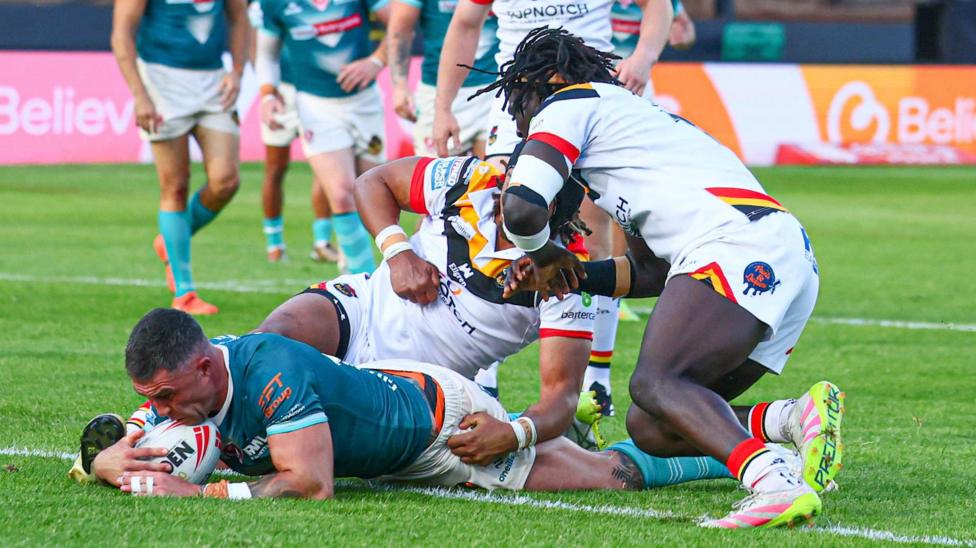
Saints Unleash 28-Point Second-Half Barrage to Storm Into Fourth
St Helens produced a devastating second-half display, shutting out Bradford with 28 unanswered points to climb into Super League's top four.

Bellingham Silences Doubts to Become Tuchel's Engine
Jude Bellingham has transformed from a selection debate into Thomas Tuchel's indispensable tactical cornerstone for England.